
Beyond Screen Time: How Gaming and Anime Can Revolutionise Learning for Neurodivergent Students
A student who struggles with literacy tasks spends hours analysing complex anime narratives. Another who finds maths worksheets overwhelming performs intricate statistical calculations to optimise gaming strategies. A third who rarely speaks in class becomes an eloquent leader in online gaming communities.
As educators, we often see these as contradictions. But what if these interests aren't distractions from learning, but powerful pathways toward it?
This isn't wishful thinking—it's supported by a growing body of research. The National Institutes of Health (2023) found that children who played video games for three hours or more per day performed better on tests involving impulse control and working memory. while meta-analytic research across 105 studies confirms positive relationships between action video game play and cognitive skills including perception, attention, and spatial abilities.
The Educational Gold Mine Hidden in Plain Sight
Gaming and anime are sophisticated learning environments engaging the same cognitive skills we're developing in classrooms.
Complex Cognitive Skills in Action
Strategic games demonstrate executive functioning (planning ahead, managing resources, prioritising objectives), mathematical reasoning (calculating probabilities, optimising allocation), analytical thinking (identifying patterns, testing hypotheses), and literacy skills (reading complex rules, interpreting narratives).
A student playing Civilization VI must understand historical concepts, manage economic systems, engage in diplomacy, and make strategic decisions—skills transferring directly to history, economics, and critical thinking curricula.
Supporting this, a 2024 systematic review by Pallavicini and colleagues, published in JMIR Serious Games, found that serious game interventions consistently improve attention, working memory, cognitive flexibility, and inhibitory control. Earlier research by Strobach and Schubert (2015) also showed that experienced video gamers outperform non-gamers in executive control skills such as shifting between information and updating working memory—abilities essential for modern classroom learning.
The Anime Advantage
Anime series feature complex storytelling requiring viewers to track character development, identify themes, understand symbolism, and interpret metaphorical content. Series like Death Note or Fullmetal Alchemist present moral dilemmas rivaling those in advanced literature courses.
Students also develop cultural competency, visual literacy, and critical thinking through anime engagement.
Understanding the Neurodivergent Learning Advantage
Hyperfocus as a Learning Superpower
What we label "attention problems" often manifests as remarkable focus in areas of interest. Students who struggle with 20-minute worksheets may spend hours mastering complex game mechanics.
This isn't a deficit—it’s a different learning style that can be leveraged for educational success. Research by Winter-Messiers and colleagues (2021) indicates that special interests are present in the vast majority of autistic individuals and function as powerful motivators for learning and engagement.
Further work by Grove et al. (2018) found that deep engagement in special interests contributes to expertise development, improved well-being, and positive long-term educational and career outcomes.
Pattern Recognition and Systematic Thinking
Many neurodivergent students excel at understanding complex systems, recognising patterns, thinking systematically, and processing detailed information in interest areas. These strengths align perfectly with gaming mechanics.
Authentic Social Learning
Gaming communities often provide neurodivergent students with successful social experiences where they connect through shared interests, demonstrate leadership, practice communication skills, and experience acceptance based on contribution rather than social conformity.
Research on autistic adolescents' engagement in online video gaming found that participants described forming and maintaining friendships, emotional regulation, and skill development as key motivators, with gaming providing a therapeutic way to disengage from everyday stressors.
Studies examining neurodivergent experiences with video games note that they provide spaces where individuals can connect through shared interests and demonstrate competence, leading to acceptance based on contributions rather than social conformity.
Practical Strategies for the Classroom
Embrace Student Expertise
Position students as experts in their interest areas. Allow presentations on related topics, use gaming references to explain concepts, and recognise analytical skills students demonstrate outside the classroom.
Example: A Pokémon-passionate student could lead lessons on taxonomy, evolution, or statistics through type-effectiveness calculations.
Think Creatively About Assessment
Provide alternative demonstration methods:
- Game design projects instead of traditional reports
- Fan fiction or anime analysis as creative writing
- Student interests as research project starting points
- Gaming elements in classroom activities
Example: Create “game guides” for novels, identifying character stats, plot “quests,” and thematic “achievements.”
Connect Interests to Curriculum
Mathematics: Use game statistics for probability and data analysis, explore geometry through game design, calculate rates through gaming economies.
Language Arts: Analyse narratives in games or anime, create character studies, write reviews or analytical essays.
Science: Examine physics in game mechanics, study biology through creature design, explore environmental themes.
Social Studies: Research historical periods depicted in media, examine cultural influences, discuss social justice themes.
Addressing Educational Concerns
“But We Have Curriculum Standards to Meet”
Interest-based learning often supports standards more effectively by increasing engagement, improving motivation, strengthening skill transfer, and enhancing retention when content connects to personal relevance.
“These Interests Are Isolating Students”
Interest-based communities frequently provide more meaningful social connections for neurodivergent students. Online gaming supports real communication skills, and shared interests create natural foundations for authentic relationships.
“Parents Complain About Screen Time”
Help parents distinguish between passive consumption and active, educational engagement. Collaborate to identify educational value, provide skill development examples, and share strategic gaming benefits research. Research from Western University found that gaming improved cognitive abilities while physical activity improved mental health, each serving different developmental purposes.
Creating Systematic Change
Professional Development
The American Journal of Occupational Therapy recognizes that neurodiversity-affirming practices are a moral imperative for occupational therapy, with recent paradigm shifts expanding conceptualizations of play to honor diverse ways of engaging.
Occupational therapy practice guidelines emphasize collaborative goal-setting that respects students' unique strengths and perspectives rather than imposing goals that align with neurotypical standards.
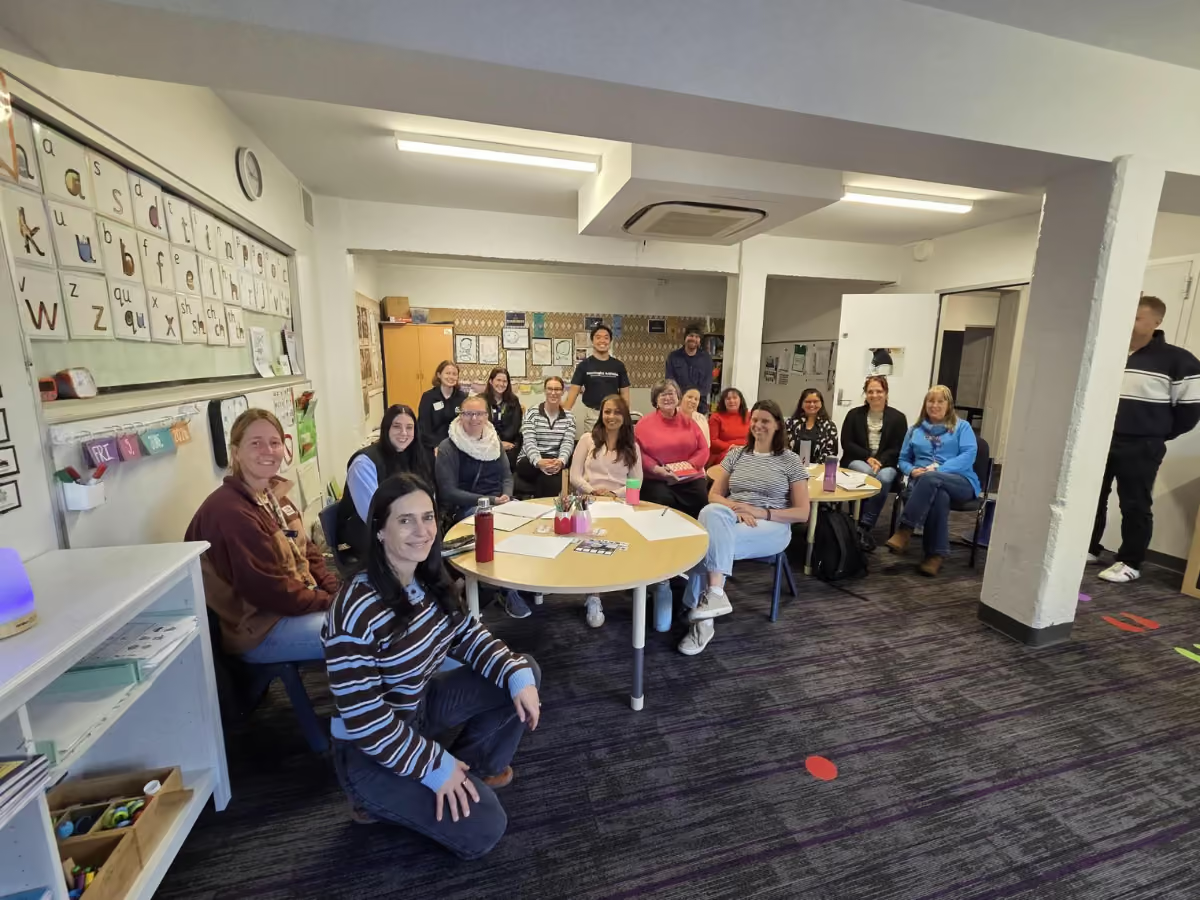
We can help train your staff on neurodivergent learning styles, recognising academic skills in non-traditional contexts, adapting assessment methods, building on strengths, and creating inclusive environments. Our workshops provide practical strategies for implementing these approaches in your setting.
Policy Review
We work with educational institutions to review policies and practices. Consider: Do assessment methods allow diverse learning demonstration? How do we recognise student expertise? Are environments sensory-friendly and flexible? We can guide this evaluation process.
Community Building
We support schools in developing interest-based programs: host gaming tournaments or anime clubs, create maker spaces, invite industry community members, celebrate diverse interests through showcases. We can help establish these initiatives in your setting.
The Ripple Effects
When schools embrace this approach:
Students: Increased engagement/motivation, better academic outcomes, stronger belonging sense, self-advocacy development, technology career preparation.
Educators: More engaging experiences, better student relationships, professional growth, increased satisfaction.
Schools: Improved achievement/attendance, stronger parent partnerships, innovative education reputation, better future-readiness.
Moving Forward: Action Steps
Start Small
- Survey student interests and passions
- Find one connection between student interest and curriculum
- Try one alternative assessment method
- Learn about student passions
Build Bridges
- Connect with parents supporting student interests
- Collaborate with teachers for cross-curricular connections
- Reach out to community members in related fields
- Share successful strategies with colleagues
The Bottom Line
Your neurodivergent students' gaming and anime interests aren't learning distractions—they're sophisticated demonstrations of exactly the thinking skills you're developing.
When we stop seeing interests as obstacles and recognise them as pathways, we help students understand their unique thinking is valuable, learning can be joyful and relevant, and they have expertise worth sharing.
The student explaining complex anime political systems has analytical skills. The student optimising gaming strategies has mathematical reasoning. The student leading online groups has communication and leadership potential.
Our job isn't replacing their interests with "academic" content but helping them see academic content already embedded in what they love.
At Meaningful Activities, we specialise in neurodiversity-affirming occupational therapy building on individual strengths and interests.
We provide professional development training to schools, kindergartens, and childcare centres on neurodiversity-affirming practices, inclusive learning environments, and recognising diverse learning styles like those demonstrated through gaming and anime engagement.
For training opportunities and neurodivergent learner support resources, visit meaningfulactivities.com.au.

Take the first step
Book an initial consultation with our team and start your journey towards growth and independence.
