
Beyond Individual Therapy: Rethinking Occupational Therapy in Education
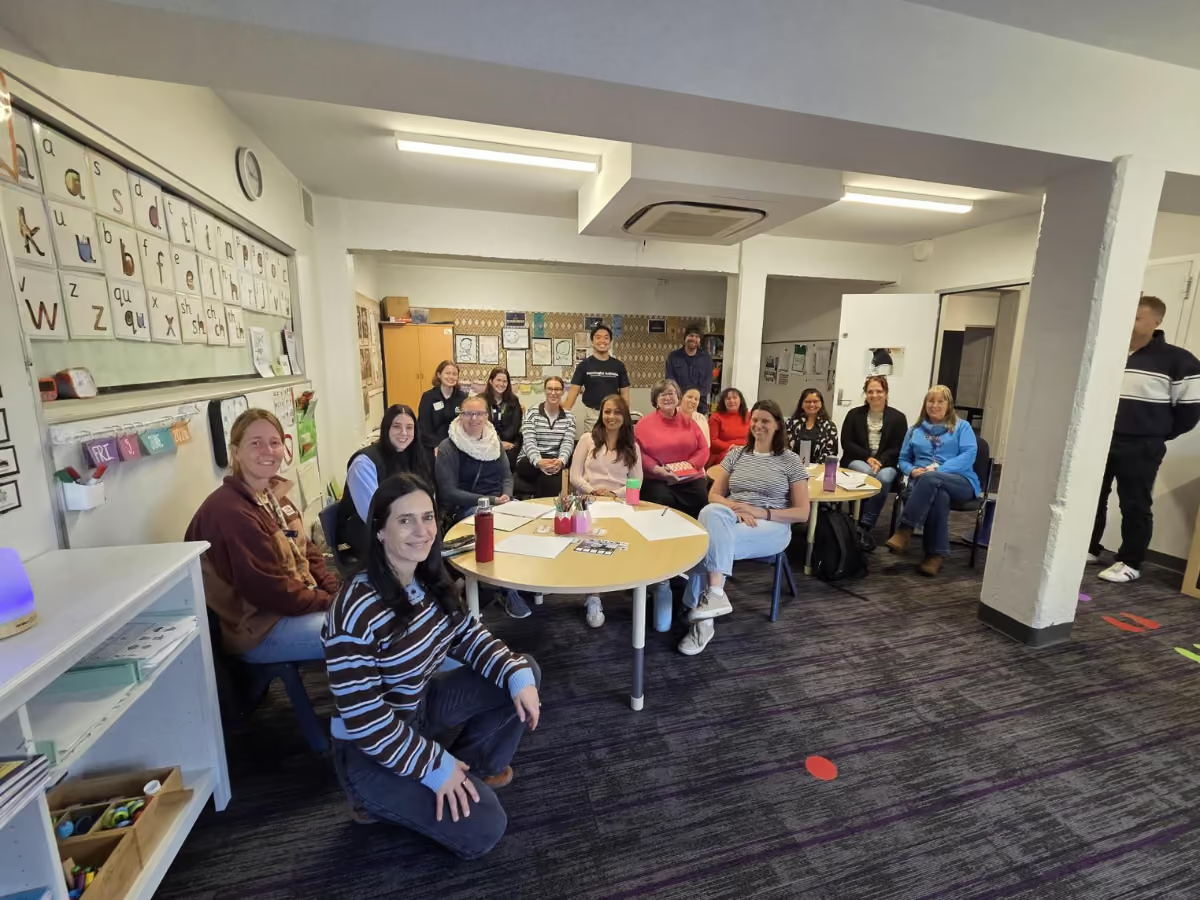
Recently, we had the privilege of facilitating a STEP Framework workshop with the School Support Officers (SSOs) and Education Support Officers (ESOs) at Kilkenny Primary School.
While the workshop was designed to introduce an occupational therapy-informed approach to understanding student participation, the conversations that emerged highlighted a much bigger discussion—one that many schools, therapists and families are beginning to have.
Where does occupational therapy sit within education?
As schools continue to support increasingly diverse student needs, and as disability and education systems evolve through reforms such as Foundation Supports and initiatives like Thriving Kids, there is growing opportunity to reconsider how occupational therapy can best support children, educators and school communities.
Looking Beyond Behaviour in Education
The STEP Framework is an occupational therapy-informed framework that supports educators and support staff to understand participation through a broader lens.
It aligns with key occupational therapy principles, including those reflected within the Person–Environment–Occupation (PEO) model, which recognises that participation is influenced by the interaction between the individual, the demands of the task and the environment.
STEP translates these concepts into practical questions that can be applied within everyday school settings through four key lenses.
- State - What is the student’s emotional, sensory and energy state right now?
- Task - Are the demands appropriate? How are instructions being delivered? Is the task too difficult, too easy, too long or too complex?
- Environment - What factors within the physical, sensory, social and organisational environment are helping or hindering participation?
- Participation - Rather than focusing solely on performance, how can we support meaningful engagement, inclusion, access and participation?
One of the most valuable discussions during the workshop centred around the concept of state.
Many educators and support staff are highly skilled at observing behaviour. However, behaviour alone rarely tells the full story.
When a student refuses work, leaves the classroom, calls out, shuts down or becomes distressed, it can be tempting to focus on the behaviour itself.
Occupational therapists are often trained to ask a different question:
“What state is this student in right now?”
Are they overwhelmed, fatigued, anxious, seeking connection or experiencing sensory overload?
When we begin by understanding a student’s state, our responses often shift from managing behaviour to supporting participation. Instead of asking, “How do we stop this behaviour?”, we begin asking, “What does this student need in order to participate?”
A Core Occupational Therapy Principle
One of the foundational principles of occupational therapy is that participation is influenced not only by the individual, but also by the tasks they are asked to do and the environments in which they are expected to do them.
Participation is rarely determined by one factor alone.
A student may have the skills required to complete a task but struggle because the environment is overwhelming, or may have strong learning potential but find the task demands exceed their current regulation or executive functioning capacity.
Students may appear disengaged when the real challenge lies in the fit between the person, the task and the environment.
This broader lens allows educators and support staff to move beyond asking: “How do we change the child?” and instead ask: “What can we adjust within the task, environment or support systems to improve participation?”
This shift is often where meaningful change begins.
Why Educators May Need Systems, Not More Strategies
One of the strongest themes that emerged from the workshop was that staff were not necessarily asking for more strategies.
In fact, the conversation quickly moved beyond strategies and towards systems.
Support staff identified that what they often need most is not another strategy sheet or behaviour management tool.
Instead, they highlighted the importance of:
- opportunities to reflect on challenging situations;
- collaborative problem-solving;
- regular case discussions;
- mentoring and coaching;
- professional learning in areas such as sensory regulation, co-regulation and executive functioning;
- shared language and understanding across teams; and
- time to think critically about participation challenges.
This was a powerful reminder that supporting students with increasingly complex needs is rarely about finding a single strategy that works. It is about creating systems that allow staff to think, reflect, learn, collaborate and adapt together.
The support staff demonstrated significant knowledge, insight and commitment. What emerged was not a need for more information, but a need for structures that support ongoing learning and collaborative decision-making.
The Unintended Consequences of Traditional School-Based Therapy
For many years, school-based occupational therapy has largely been shaped by individual funding models, particularly through the NDIS.
In practice, this has often looked like a therapist arriving at school, collecting a student from class, delivering a therapy session, returning the student to class and then moving on to the next school.
This model has undoubtedly helped many children access valuable support. However, it has also created some unintended consequences.
For instance, teachers and support staff are often required to coordinate multiple therapists, manage schedules, communicate recommendations and balance competing priorities throughout the school day. As a result, classroom routines can be interrupted, administrative demands can increase and communication can become fragmented.
In some cases, therapists become visitors to the school rather than partners with the school.
Meanwhile, the people who spend the most time supporting students—teachers, SSOs, ESOs, leaders and families—continue navigating the day-to-day realities of participation, including the transitions, emotional regulation challenges, friendship difficulties, executive functioning demands, classroom expectations, and playground incidents.
The reality is that participation does not only occur within a therapy room. It also occurs within the environments where children learn, play, connect and grow.
A Shift Towards Capacity Building
As educational systems continue to evolve, there is increasing recognition that supporting the adults around the child can have a significant impact on participation outcomes.
This does not mean replacing individual therapy. Rather, it means complementing individual supports with broader approaches that strengthen the capacity of those who support children every day.
This may include:
- educator and SSO mentoring;
- collaborative consultation and coaching;
- professional learning workshops;
- parent capacity-building programs;
- wellbeing and resilience initiatives;
- environmental reviews and recommendations;
- coaching around regulation and executive functioning;
- participation-focused planning;
- reflective practice and case discussions; and
- whole-school approaches to inclusion and wellbeing.
These approaches recognise that sustainable outcomes often occur when knowledge and skills become embedded within everyday environments.
When educators feel confident.
When support staff have opportunities to problem-solve together.
When families understand the principles behind the strategies.
When school systems support participation.
The impact extends beyond a single child.
Looking Ahead: Foundation Supports and Thriving Kids
With the introduction of Foundation Supports and initiatives such as Thriving Kids, schools are likely to play an increasingly important role in supporting children with participation, developmental, behavioural and regulation needs.
While the details of these reforms continue to emerge, they signal a broader shift towards:
- prevention rather than crisis response;
- early support and intervention;
- capacity building;
- community-based services;
- greater collaboration across sectors; and
- supporting children within their everyday environments.
For occupational therapists, this presents an opportunity to think differently about where our skills can have the greatest impact.
Perhaps the future of occupational therapy in education is not simply about delivering more therapy sessions. Instead, it may be about helping schools build the confidence, capability, wellbeing and systems required to support all learners.
In other words, it may involve supporting not only the child, but also the adults, environments and systems that influence participation every day.
The Future of Occupational Therapy in Education
Our experience at Kilkenny Primary reinforced something we continue to see across education settings: the adults supporting children already hold enormous knowledge, experience and commitment.
What they often need is not another strategy sheet. They need opportunities to think, reflect and problem-solve together, develop shared ways of understanding participation, and build confidence in supporting increasingly complex needs.
As occupational therapists, perhaps one of our most important roles is to ask not only, “How do we support this child?” but also, “How do we support the system around them?”
Because when we strengthen the people, environments and systems around children, we create more opportunities for meaningful participation, inclusion, wellbeing and success for everyone.
If your school is exploring how occupational therapy could support participation, capacity-building and systems-level change in your school, get in touch to learn more about STEP Framework workshops and educator coaching for schools.

Take the first step
Book an initial consultation with our team and start your journey towards growth and independence.
